
Self-Service Cannabis Kiosks: What Operators Should Know Before They Deploy
Self-service is one of the few investments in cannabis retail where the math can be straightforward: shorter lines, larger baskets, and less pressure on the front of house when the Friday rush hits harder than expected.
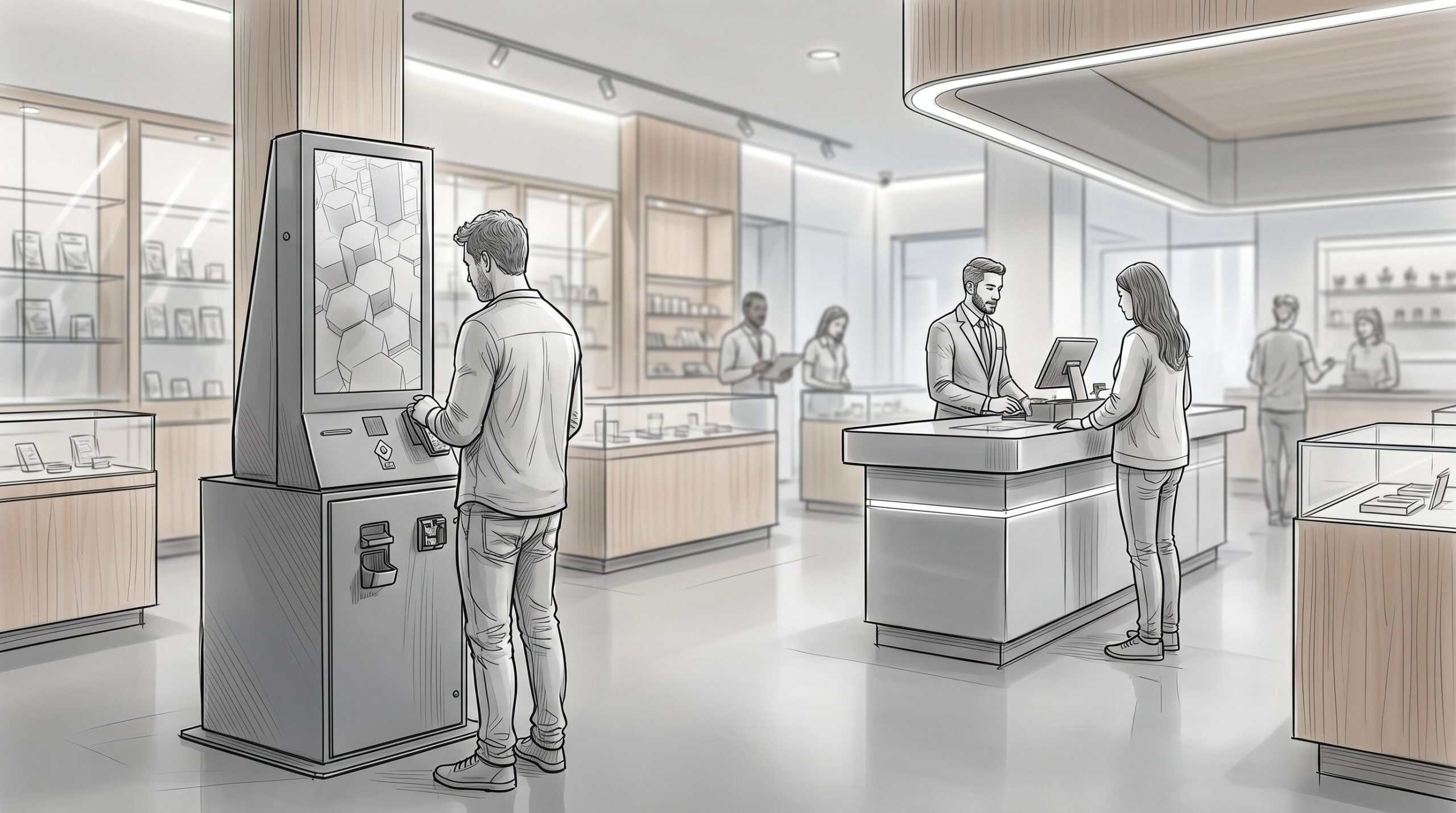
Customers already know the behavior from every other part of retail. A lot of them would rather build an order on a screen than talk through it at the counter while people wait behind them.
The rollouts that underperform usually fail for the same reason. The store did not actually deploy a self-service cannabis kiosk. It deployed kiosk software, mounted a consumer tablet to a stand, and hoped the rest of the workflow would hold together.
Then the ID scanner does not talk cleanly to the POS. Payment still gets pushed to the counter. Cash stays manual. The receipt printer lives somewhere else. The kiosk freezes during a rush, and the whole self-service idea gets blamed when the real issue was the hardware layer.
Self-service in cannabis is not just a menu on a screen. It is a hardware, payment, compliance, and support decision.
Four different things get called a kiosk
The word kiosk gets used too broadly. In practice, most dispensaries are talking about one of four workflows.
1. Check-in
The customer walks in, scans an ID, and joins the queue without waiting on someone at the front desk.
This is usually the easiest win. It reduces the first bottleneck in the store, especially for returning customers who do not need much help. If the ID scan is fast and the queue handoff is clean, check-in removes a lot of small friction from the front of house.
2. Self-ordering
The customer browses the menu, builds a cart, and sends the order to fulfillment.
This is what a lot of dispensary kiosks are today: a menu on a touchscreen. It can still be useful. Customers can browse without pressure, compare products, and build the order at their own pace. But if a budtender still has to handle payment and handoff, the store is not really at self-checkout yet.
3. Self-payment
This is where the deployment gets more serious. Card payment is one layer. Cash is another.
Cannabis is still a cash-heavy category, and a kiosk that cannot accept bills or return change will push a meaningful share of customers right back to the counter.
A cash-capable kiosk is a different machine from a tablet running menu software. It needs payment hardware, bill validation, change handling, receipt printing, POS handoff, and support that works when the store is busy.
4. End-to-end self-checkout
This is the full version: check in, browse, order, pay, and move to handoff with minimal staff involvement unless the customer needs help.
That is where the bigger return lives. It is also where the gap between a real cannabis kiosk and a tablet on a stand becomes obvious.
Most stores deploy the first two steps and assume they have done self-service. The gains are real, but partial. The more of the workflow your hardware can carry, the more the investment starts to pay back.
The throughput math depends on execution
Most hard data lives in quick-service retail, where self-order kiosks have been around longer, but the behavior carries over. When customers order on a screen instead of out loud at a counter, baskets tend to grow. McDonald's has pointed to roughly a 30 percent lift in average order value after rolling out kiosks, and QSR studies often land in the 15 to 30 percent range.
Cannabis-specific numbers vary by platform and store type, but the pattern is familiar: customers explore more when they are not trying to make a decision out loud at the counter, upsell prompts do quiet work in the background, and budtenders are no longer stuck doing repetitive order entry for every basic transaction.
But those numbers are not automatic. The difference between a good deployment and a mediocre one is usually operational:
- Does the ID scanner work the first time?
- Does the kiosk stay online during peak hours?
- Does the POS handoff happen cleanly?
- Can the customer pay at the kiosk, or do they still have to wait at the counter?
- Does someone answer when the hardware breaks?
A kiosk that scans IDs in two seconds gets used. One that takes four attempts gets abandoned. A kiosk that goes down for an hour on Friday night does not just lose its own transactions. It backs up the floor around it.
The throughput gain vendors advertise is really a hardware reliability and workflow-design story.
Self-service raises the compliance bar
Self-service does not make cannabis compliance simpler. It makes the workflow more dependent on the system doing its job correctly every time.
A kiosk transaction without a verified and recorded ID scan is harder to defend than a counter sale. There was no budtender in the loop to say they checked. The system needs to scan the ID, verify the customer, apply the right purchase-limit logic through the POS, and leave a clean record of what happened.
That does not mean self-service is a compliance problem. It means the hardware and integrations need to be treated as compliance infrastructure, not just convenience tools.
State rules matter too. Some markets still require budtender involvement in parts of the customer experience. That may mean the kiosk handles check-in, browsing, and payment while staff still handles consultation, exceptions, and handoff.
ADA is in the same category. Touchscreen height, reach ranges, floor placement, and accessibility support are part of the deployment, not nice-to-have features.
The hardware layer is where most deployments live or die
The major cannabis POS platforms have good kiosk software. That is not the issue. The issue is what that software is running on.
If the screen, scanner, payment device, printer, mount, and support model are stitched together after the fact, the store inherits that complexity. Maybe it works when traffic is light. The real test is whether it works for twelve-hour retail days, peak traffic, cash payments, compliance checks, and staff who do not have time to troubleshoot four vendors.
Screen and form factor
A consumer tablet was not built for dispensary traffic, constant use, greasy fingers, and the occasional shoulder check from a customer walking by.
Retail-grade hardware matters. So does form factor. Floor-standing, wall-mounted, and counter units all change how people move through the store. They also affect accessibility and ADA fit.
ID scanning
Scan speed is adoption. If it works cleanly, customers trust it. If it fails twice, they get in line and the kiosk becomes furniture.
The scanner also needs to feed the actual verification and compliance workflow. If it is just another device someone reconciles later, it is not solving the right problem.
Payment
EMV and contactless should be expected. Cash is where cannabis gets different.
A self-service kiosk that cannot handle cash will still send a large portion of transactions back to the counter. The Giosk 32 Cash is built around that distinction. With the optional cash recycler configured, it accepts bills and returns change at the point of sale, which is the difference between self-ordering and an actual cash-aware checkout path.
The back-of-house cash side matters too. Counting and verifying cash after it enters the store is a separate operational problem, which is why Dispensify also covers the cash management side.
Receipts and order routing
A printer jam can stop a line. A slow fulfillment handoff can move the bottleneck instead of removing it.
The kiosk needs to push the order into the store's fulfillment flow quickly and consistently. Otherwise, the front-end experience looks modern while the back end still runs like a workaround.
Support ownership
Hardware will fail eventually. The real question is what happens next.
If the screen vendor blames the software vendor, the software vendor blames the payment device, and the payment vendor blames the network, the store is stuck. That may be tolerable for a back-office tool. It is not tolerable for a customer-facing checkout lane.
You want one accountable party for the terminal, scanner, payment hardware, peripherals, integration, and support path. That is the lane Dispensify built the Giosk line around: purpose-built cannabis retail terminals that work with the POS platforms operators already run.
Multi-location rollouts need a tighter spec
A self-service setup that works at one store can get messy across five. Standardize the hardware spec, keep the POS, ID verification, payment, and compliance workflow as consistent as possible, make sure the fleet can be monitored and supported remotely, and plan for connectivity issues before they happen.
This is the same multi-site infrastructure problem operators already understand from POS, inventory, security, and networking. The kiosk is the machine customers touch most, so weak implementation shows up fast.
Six questions to ask before you buy
If you are evaluating self-service cannabis kiosks, these six questions will tell you more than most vendor demos:
- Are we deploying check-in, ordering, payment, or full self-checkout?
- Is the hardware built for cannabis retail, or is this a tablet in a metal shell?
- Does it integrate with our POS, ID verification, payment, and compliance workflow out of the box?
- Can it handle cash at the kiosk, or does cash still go back to the counter?
- Who supports the hardware when it fails, and is that one accountable vendor or several?
- Can this same spec work across every location we operate or plan to open?
If the answers get vague on cash handling or support ownership, that is the signal.
The bottom line
Self-service is not new in cannabis anymore. In competitive markets, customers already expect some version of it. The operators getting the most value are the ones treating it as an infrastructure decision, not a software feature.
The gains are real: shorter lines, cleaner order flow, better basket-building, and less repetitive work for staff. But they do not come from the menu on the screen. They come from the machine underneath it doing the boring work correctly every hour the store is open.
If you are evaluating self-service for your dispensary, talk to Dispensify about the actual deployment. We will walk through the workflow, hardware, cash path, POS fit, and support model before you put anything on the floor.
Frequently asked questions
01Do self-service kiosks replace budtenders in a dispensary?
No. The best deployments usually redeploy budtenders instead of replacing them. The kiosk handles repetitive work like check-in, browsing, basic order entry, and payment. Budtenders stay focused on product education, recommendations, complex orders, exceptions, and handoff.
02How much faster do dispensaries operate with self-service kiosks?
Most published numbers come from quick-service retail, where kiosks are more established. Average order value commonly rises 15 to 30 percent, and self-service tends to lift throughput once the line stops bottlenecking at a single counter. In cannabis, the high end depends on hardware reliability, POS integration, payment flow, and whether the kiosk actually gets used during peak traffic.
03Can a self-service kiosk handle cash payments in a dispensary?
Yes, but only if the kiosk is built for it. Cash-capable kiosks need bill validation, change handling, counterfeit detection, secure cash storage, receipt printing, and POS/payment integration. Most general-purpose retail kiosks and tablet-based setups do not cover that full workflow, which is why cash still gets routed to the counter.
04Are self-service kiosks compliant with cannabis regulations?
They can be, but the workflow has to be auditable. ID verification, purchase-limit logic, POS or seed-to-sale handoff, exception logging, and ADA accessibility all need to be part of the deployment. Self-service does not remove compliance work. It moves more of that work into the system.
05What is the difference between a self-service kiosk and a self-ordering tablet?
A self-ordering tablet usually lets customers browse and build an order. A purpose-built self-service kiosk can combine the touchscreen, ID scanner, EMV/contactless payment, optional cash module, receipt printer, and POS handoff in one retail-grade terminal. That is the difference between a digital menu and an actual checkout lane.
More from the blog
 From dispensary license to opening day: what operators wish they’d knownMost advice about opening a dispensary stops at the license. The hard part starts after it. Between the award letter and the first sale, you’re locking down a location, writing procedures your state will inspect against, coordinating a build-out, standing up technology and banking, and training a team that’s never worked together.Read article
 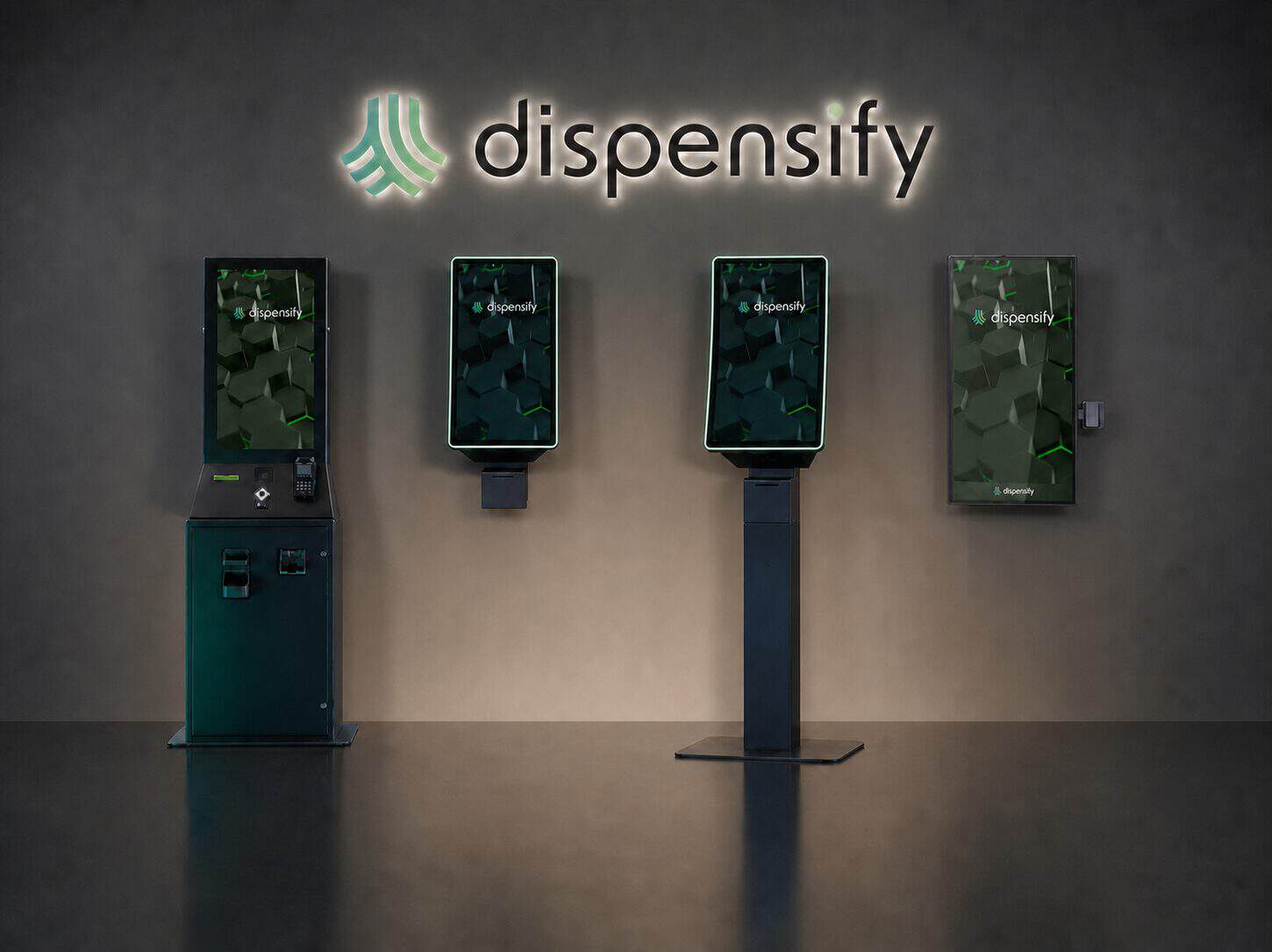 How to Size Self-Service Dispensary Kiosks for Your StoreDo not guess from square footage or buy one kiosk just to test the idea. Use your busiest hour, target self-service share, measured kiosk capacity, floor plan, and fulfillment workflow to size the right number of dispensary kiosks.Read article
  Self-Checkout Isn't Replacing Your Budtenders. It's Promoting ThemThe best stores give customers a choice between the fast lane and a real conversation. One line for everyone isn't a standard, it's a design flaw.Read article
  Standardize Checkout, Cash, and Kiosks Across Every LocationDispensify helps MSOs and multi-store cannabis operators deploy the same checkout, cash, and kiosk stack in every store, with one team for configuration, rollout, and support.Read article
  Dispensary Compliance Checklist for POS, Kiosks, and InventoryMost operators think about dispensary compliance as licensing paperwork. The application, the renewals, the annual fees, the state forms with deadlines.Read article
  Cannabis Cash Automation for Dispensary CheckoutMost dispensaries close the same way they did the day they opened. The doors lock, and a manager sits down at a back table to count the drawer by hand. The store got busier, the lines got longer, the deposits got heavier, and the cash room never changed.Read article